
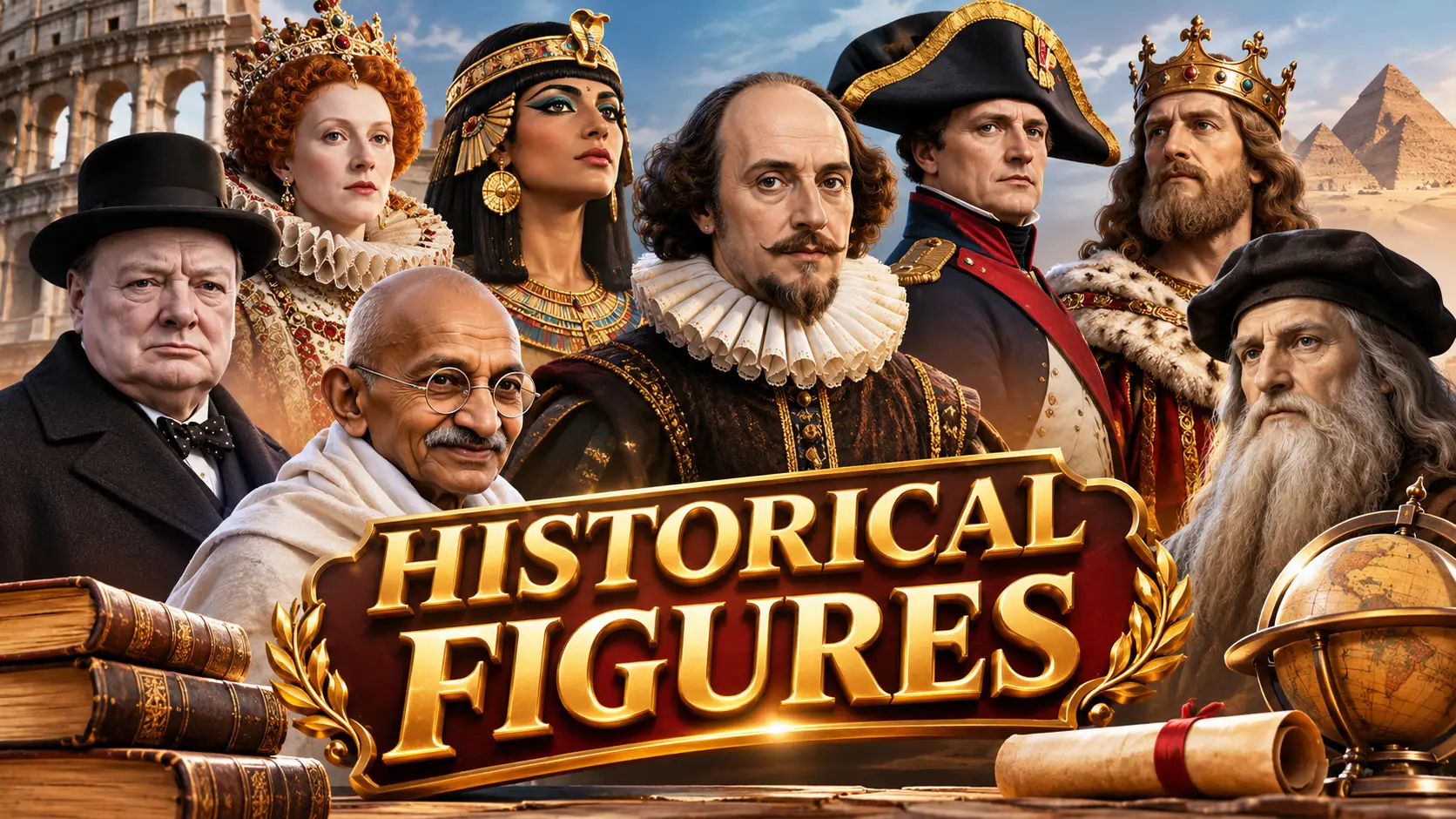

Historical figures are people whose actions, achievements, and decisions have influenced the world. They come from different periods, cultures, and backgrounds. Some changed politics, while others transformed science, education, art, and society. Their stories help us understand how the modern world developed. Historical figures include kings, queens, scientists, leaders, inventors, writers, and explorers. Their contributions continue to inspire people across generations. Learning about these important personalities also helps us understand past events and their effects on modern life. From ancient civilizations to recent history, their lives offer valuable lessons about human progress.
What Are Historical Figures?
Historical figures are individuals who played important roles in shaping historical events and societies. Their actions may have influenced governments, scientific discoveries, cultural movements, or major social changes. Some became famous because of their leadership, while others earned recognition through knowledge, creativity, or courage. For example, Albert Einstein transformed modern physics through his scientific work. Similarly, Nelson Mandela became an important symbol of equality and freedom. These individuals are remembered because their contributions created lasting effects beyond their own lifetimes.
Not every famous person from the past is considered an important historical figure. Their significance usually comes from their influence on people, institutions, or important events. Historians study their lives using documents, photographs, letters, books, and other historical evidence. They also examine different viewpoints to understand their actions fairly. Some figures are remembered for positive achievements, while others are studied because of harmful decisions. Understanding both sides provides a clearer picture of history. It also helps readers separate historical facts from myths, popular stories, and personal opinions. Read More : Return on Investment
Famous Historical Figures Who Changed the World
Many historical figures have influenced the development of modern civilization. <escape>Leonardo da Vinci</escape> was an Italian artist, inventor, and thinker known for remarkable works such as the Mona Lisa. His interests included painting, anatomy, engineering, and scientific observation. <escape>Isaac Newton</escape> made important contributions to mathematics and physics. His laws of motion and theory of universal gravitation helped establish foundations for classical physics. Their work demonstrates how curiosity, creativity, and careful observation can change human understanding. Their contributions remain important subjects in education and scientific research today.
Other influential personalities changed politics, society, and human rights. <escape>Mahatma Gandhi</escape> became widely known for promoting nonviolent resistance during India’s independence movement. <escape>Martin Luther King Jr.</escape> played a major role in the American civil rights movement. <escape>Nelson Mandela</escape> fought against apartheid and later became South Africa’s first Black president. Their experiences demonstrate the importance of leadership, determination, and social responsibility. Although they worked in different countries and historical situations, their efforts influenced discussions about equality, freedom, justice, and human dignity around the world.
Historical Figures of Ancient Civilizations
Ancient civilizations produced many influential leaders, thinkers, and rulers. <escape>Alexander the Great</escape> created one of the largest empires of the ancient world through military campaigns. His conquests helped spread Greek culture across several regions. <escape>Julius Caesar</escape> was another important historical personality who transformed Roman politics and military power. His rise influenced the end of the Roman Republic and the development of imperial government. These leaders remain important subjects of historical research because their decisions affected political systems, territorial boundaries, and cultural exchange.
Ancient history also includes philosophers and rulers who influenced knowledge and society. <escape>Socrates</escape> helped shape Western philosophy through his questioning and teaching methods. His ideas influenced later thinkers, especially Plato. <escape>Cleopatra VII</escape> was the last active ruler of the Ptolemaic Kingdom of Egypt. She played an important role in the political struggles of the ancient Mediterranean world. Meanwhile, <escape>Confucius</escape> developed teachings that influenced Chinese philosophy, education, and social values. Their contributions show that ancient history includes much more than wars and powerful kingdoms.
Famous Women in Historical Figures
Women have played important roles throughout history, even when traditional records gave them limited recognition. <escape>Marie Curie</escape> was a pioneering scientist who conducted important research on radioactivity. She became the first woman to receive a Nobel Prize and remains the only person awarded Nobel Prizes in two different scientific fields. <escape>Rosa Parks</escape> became an important figure in the American civil rights movement after refusing to give up her bus seat in Montgomery, Alabama, in 1955. Her action helped inspire the Montgomery Bus Boycott and wider protests against racial segregation.
Several other women also changed politics, education, and culture. <escape>Joan of Arc</escape> became a French national heroine because of her role during the Hundred Years’ War. <escape>Ada Lovelace</escape> is widely recognized for her early work on Charles Babbage’s proposed Analytical Engine. Her notes included an algorithm designed for the machine. <escape>Malala Yousafzai</escape> became internationally known for advocating girls’ education. She received the Nobel Peace Prize in 2014. These women demonstrate how courage, intelligence, and determination can influence society across different generations.
Historical Figures in Science and Technology
Scientific progress has been shaped by individuals who challenged existing ideas and discovered new possibilities. <escape>Galileo Galilei</escape> made important contributions to astronomy and physics through observation and experimentation. His support for heliocentrism challenged widely accepted beliefs about Earth’s position in the universe. <escape>Charles Darwin</escape> developed the theory of evolution by natural selection, transforming biological science. <escape>Albert Einstein</escape> introduced the theory of relativity, which changed how scientists understand space, time, and gravity. Their discoveries continue influencing scientific education and research around the world.
Technology also developed through the work of creative thinkers and inventors. <escape>Nikola Tesla</escape> contributed significantly to electrical engineering, particularly alternating-current power systems. <escape>Thomas Edison</escape> became famous for developing and improving several electrical technologies, including practical electric lighting systems. <escape>Alan Turing</escape> made important contributions to computer science and wartime codebreaking. His theoretical work helped shape modern computing. These historical figures demonstrate how scientific research and technological innovation can transform everyday life. Their achievements also encourage new generations to explore mathematics, engineering, and technology.
Historical Figures in Politics and Leadership
Political leaders have influenced the borders, laws, and institutions of many countries. <escape>Abraham Lincoln</escape> served as the 16th president of the United States. He led the country during the American Civil War and issued the Emancipation Proclamation in 1863. <escape>Winston Churchill</escape> became an important British leader during the Second World War. His speeches and leadership helped maintain public determination during a difficult period. Their political decisions influenced national history and continue to attract attention from historians, students, and political researchers.
Other leaders became important because of their influence on independence and national development. <escape>Muhammad Ali Jinnah</escape> was the leading figure in the creation of Pakistan in 1947 and became its first Governor-General. <escape>George Washington</escape> served as the first president of the United States and played a central role in the American independence movement. <escape>Nelson Mandela</escape> helped bring an end to apartheid and supported democratic change in South Africa. Studying these leaders provides useful insights into political systems, national identity, diplomacy, and the challenges of governing societies.
Why Are Historical Figures Important Today?
Historical figures help modern generations understand how societies developed over time. Their experiences explain the origins of political systems, scientific knowledge, cultural traditions, and social movements. For example, studying Marie Curie’s research helps students understand the development of modern science. Learning about Martin Luther King Jr. explains important struggles for civil rights. These stories also show how individual decisions can influence larger communities. History becomes easier to understand when major events are connected with the people who experienced, influenced, or challenged them.
Their stories also provide lessons about leadership, responsibility, creativity, and human behavior. However, studying historical figures should involve critical thinking rather than simply celebrating famous names. Some individuals achieved remarkable progress while also making controversial decisions. Understanding their strengths and failures creates a more balanced view of history. Readers can explore our related articles about famous world leaders and influential scientists to learn more. A deeper understanding of historical events also helps people recognize how past decisions continue affecting modern society.
How to Research and Learn About Historical Figures
Researching historical figures requires reliable information and careful evaluation. Start by identifying the person’s full name, birthplace, historical period, and major achievements. Then examine important events connected with their life. Biographies, historical books, academic publications, museum collections, and original documents can provide useful evidence. Comparing multiple sources helps identify differences in historical accounts. This is especially important when researching individuals whose lives are surrounded by myths or political debates. Accurate research should separate confirmed facts from opinions, assumptions, and unverified stories.
Students can also make learning easier through timelines, photographs, maps, and documentaries. A timeline helps explain when important events happened and how they were connected. Maps show where historical figures lived, traveled, or carried out important activities. Comparing two personalities from the same period can also reveal different approaches to similar challenges. For example, studying Gandhi and Martin Luther King Jr. together helps explain the influence of nonviolent resistance. These methods make history more interesting, organized, and easier to remember for students and general readers.
Frequently Asked Questions About Historical Figures
1. What are historical figures?
They are important individuals whose actions influenced historical events and society.
2. Who is the most famous historical figure?
There is no single answer because fame and influence vary across cultures.
3. Who are some famous female historical figures?
Marie Curie, Cleopatra, Rosa Parks, Joan of Arc, and Ada Lovelace.
4. Why should we study historical figures?
Their lives help us understand history, leadership, discoveries, and social change.
5. Who are the most influential historical scientists?
Isaac Newton, Albert Einstein, Galileo Galilei, and Marie Curie are major examples.
Conclusion
Historical figures have shaped the world through leadership, discoveries, creativity, and social movements. Their achievements help explain how modern societies developed and changed. From ancient rulers to modern scientists, their stories offer valuable lessons about human progress. However, understanding history requires looking at both achievements and mistakes. Studying reliable sources also helps separate historical facts from popular myths. Whether you are a student, researcher, or history enthusiast, exploring influential personalities can make the past more meaningful. Continue discovering our biographies, historical events, and educational articles to learn about the people who helped shape our world.












One thought on “Historical Figures: Famous People Who Changed History”